
Toshiba e-STUDIO 4525AC
45ppm A3 Colour Photocopier
The Toshiba e-STUDIO 4525AC prints and copies in colour or black and white at up to 45ppm on A4 and 22ppm on A3. Its faster A4 output suits teams producing longer reports and repeated document sets, with optional single-pass scanning and finishing. Available to buy, lease or rent from Camelott®, with UK-wide service and repair support.
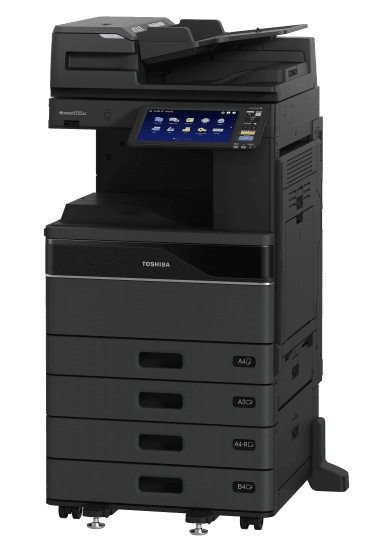
The Toshiba e-STUDIO 4525AC is a 45ppm A3 colour multifunction photocopier, printer and scanner. Its combination of faster batch output and shorter first-copy times makes it worth considering for a shared office handling both walk-up copying and recurring document packs. This Toshiba 4525AC photocopier delivers up to 22ppm A3, with optional 300-sheet single-pass scanning, 300gsm cassette support and compatible stapling, booklet making and hole punching. Available to buy, lease or rent from Camelott®, with UK-wide service and repair. The range photograph shows optional extra drawers; confirm the feeder, stand, trays and finishing included in your proposal.
Camelott® 360° view
Toshiba 4525AC Photocopier: Less Waiting Across a Busy Working Day
A useful step up when long print batches and short copy jobs share the same machine. The 4525AC raises A4 output to 45ppm and A3 to 22ppm. Unlike an upgrade within the lower-speed part of this family, it also improves the published first-copy times: approximately 5.7 seconds colour and 4.4 seconds mono.
For a 200-page A4 run, theoretical engine time is about 4 minutes 27 seconds, compared with 5 minutes 43 seconds at 35ppm. That is around 1 minute 16 seconds less before allowing for processing, the first page, paper choice and finishing. Repeated jobs make that difference more useful than an occasional long report would.
The right accessories still matter. A faster engine will not remove the time staff spend stapling packs, changing stock or routing scans. Specify the feeder, paper drawers and finishing around those tasks. If printing is light and scanning dominates, a lower-speed engine with the right scanner may be the more economical choice.
Click the part you want to understand
Explore the e-STUDIO 4525AC Part by Part
Select an area to see the specification, what it means in practice, and when it will—or will not—make a meaningful difference.
1. Document feeder & scanning
Choose Scanning for the Originals, Not the Print Speed
The 4525AC can use a 100-sheet reversing feeder or an optional 300-sheet single-pass DSDF. The faster print engine does not increase the top scan rating.
Why this is useful
The DSDF captures both sides without reversing each original, useful for substantial accounts files, signed contracts and double-sided records. A version with double-feed detection is available. Choose it when the batch sizes and original types justify the option.
What to weigh up
A 300-sheet feeder is not unique in the 45ppm class: some alternatives also offer that capacity or include a single-pass feeder. Compare the complete supplied cost, resolution, original handling and finished file time. A headline measured at 200dpi is not directly comparable with 240ipm at 300dpi.
2. Touchscreen & workflow
Make Regular Department Jobs Easy to Repeat
The 10.1-inch multi-touch panel and e-BRIDGE Next platform can be configured around the tasks people repeat across the office.
Why this is useful
A preset for a stapled meeting pack or a saved scan destination can reduce the settings staff must remember. Compatible apps can connect supported cloud workflows, while the installation should establish permissions and destinations that make sense to the team.
What to weigh up
A touchscreen is common in this class; the useful part is a setup people understand. *Apps, subscriptions and licences depend on the supported configuration and availability. Confirm what is supplied rather than assuming every connector is included.
3. Print engine
45ppm A4, with a Quicker First Copy
The 4525AC improves both sustained output and first-copy figures compared with the 25–35ppm models in this family.
Why this is useful
A 200-page A4 engine run takes about 4 minutes 27 seconds, roughly 1 minute 16 seconds less than 35ppm. First-copy figures also improve from approximately 7.8 to 5.7 seconds colour and 5.9 to 4.4 seconds mono. This combination can suit a mix of longer reports and walk-up copying.
What to weigh up
Those are separate manufacturer measurements, not a guaranteed saving on every PC print job. Comparable 45ppm machines can have quicker first-copy figures. Judge the complete job using your files, media and finishing rather than expecting the fastest first page in the class.
4. Bypass & specialist media
Handle Occasional Stock Without Disrupting the Main Drawers
The 100-sheet bypass provides a separate path for suitable specialist jobs while regular A4 and A3 stock stays loaded.
Why this is useful
Covers, certificates and suitable banners can be produced between routine office jobs without replacing the paper in a main drawer. Correct settings and approved stock help make those jobs repeatable.
What to weigh up
Do not apply the 45ppm plain-paper figure to every heavy stock or banner. Banner media has its own 90–163gsm range; automatic duplex supports 60–256gsm. The feeder and finishing equipment have separate restrictions.
5. Main paper drawers
Keep the Engine Supplied with the Paper People Use
Standard input is 1,200 sheets: two 550-sheet cassettes plus the 100-sheet bypass. Extra drawers and capacity are optional.
Why this is useful
At a higher output rate, an avoidable paper change can cancel part of the speed benefit. Separate drawers for A4, A3, letterhead or approved heavier covers can keep repeated jobs moving. Cassette support to 300gsm is useful against configurations whose main trays stop at 256gsm.
What to weigh up
Other 45ppm configurations offer substantial input too, sometimes a higher maximum. Choose drawers for the sizes and stocks you need ready. The 5,200-sheet maximum requires the right accessories; the photograph does not establish what is included.
6. Output & finishing
Turn a Faster Print Run into a Finished Pack
Printing sooner helps most when the pages are ready for use. Select corner stapling, booklet making and hole punching as separate tasks.
Why this is useful
An inner stapler can remove repetitive work from meeting reports without choosing a large booklet unit. Folded training guides need the matching saddle-stitch equipment. Binder packs need the correct punch pattern. Match each option to the documents staff actually assemble.
What to weigh up
Other machines in this speed class may offer larger booklet capacities or different folding functions. Check a sample of your longest pack. *Limits depend on the accessory, sheet size and weight; a 60-page booklet is not 60 sheets, and 300gsm print support is not a stapling or folding limit.
Photocopier terminology, explained by Bean
Confused by Photocopier Jargon?
Bean explains the terms without the technical waffle. Here is what the specifications mean for your working day.

- PPM — Pages Per Minute
- Printer PPM measures pages produced per minute once the print engine is running, under specified test conditions. The difference between 35ppm and 45ppm matters much more on a 100-page job than a five-page job, where processing and the first page account for more of the wait.
- IPM — Images Per Minute
- Scanner IPM normally measures scanned sides, not sheets. One double-sided sheet counts as two images. A high figure helps with large scan batches, but resolution, OCR, file processing and upload speed can still slow the complete job.
- GSM — Grams Per Square Metre
- GSM describes paper weight per square metre; ordinary office paper is often 80gsm. Support for 300gsm can help with covers and certificates, but adds little if you only print standard paper. Check the tray and duplex limits too: this model’s automatic duplex limit is 256gsm.
- MFP — Multifunction Printer
- One device combines printing, copying and scanning; fax may be optional. Sharing an MFP saves space, but a busy scan or copy session can create a queue, so consider how many people need it at once.
- ADF — Automatic Document Feeder
- An ADF feeds a stack of originals into the scanner, saving you from placing every page on the glass. Capacity matters for long batches. ADF alone does not tell you whether both sides are scanned automatically; check the feeder type.
- DSDF — Dual Scan Document Feeder
- A DSDF scans both sides of an original in one pass, without turning the sheet over. It is especially useful for large double-sided document packs. On the 4525AC, the 300-sheet DSDF is an option, so check that it is included.
- RADF — Reversing Automatic Document Feeder
- A RADF scans one side and reverses the sheet to scan the other. It still handles double-sided originals automatically, but the reversing step makes it slower than a dual-scan feeder. It can be quite sufficient for occasional smaller batches.
- DADF — Duplexing Automatic Document Feeder
- DADF describes an automatic feeder that handles double-sided originals. Check whether the actual configuration scans both sides in one pass or reverses each sheet: the mechanism, scan speed and capacity matter more than the initials. A standard single-pass feeder can offer good value when it handles your normal batches without an upgrade.
- Duplex — Automatic Double-sided Printing
- Automatic duplex prints on both sides without manually reloading the paper. It saves paper and reduces bulky packs. It does not mean double-sided scanning, and supported paper weights can be lower than for single-sided printing.
- DPI — Dots Per Inch
- DPI describes resolution: how many dots are printed, or how finely a scan samples detail, per inch. Higher settings can help fine text and images, but scanning at higher resolution creates larger files and can slow the workflow. Match the setting to the task.
- CPC — Cost Per Copy
- CPC is the charge per copy or printed page under a service arrangement, normally with different rates for mono and colour. Ask what is included, how A3 and double-sided pages are counted, and whether minimum billing applies. Compare the rates against your actual usage.
- FCOT — First Copy Out Time
- FCOT is the time to produce the first copy under the manufacturer’s test conditions. It is not PC-to-first-printed-page time: a PC print job can also involve the computer, application, driver, network, server or cloud, copier processing and print engine. Sleep state can add a further wait.
- A4 / A3 — Paper Sizes
- A4 is 210 × 297mm, the usual office page. A3 is 297 × 420mm, twice the area of A4, useful for plans, larger spreadsheets and folded A4 booklets with suitable finishing. If you never use A3, a smaller A4 device may suit a lighter workload, but check paper capacity, sustained use and any finishing attachments you may need later.
- Booklet Maker — Folded, Stapled Booklets
- A booklet maker folds sheets down the middle and staples along the fold to produce a finished booklet. With suitable paper and finishing, A3 sheets become an A4 booklet and A4 sheets become an A5 booklet. Useful for handbooks, programmes and training guides. It is a separate finishing requirement from corner stapling: check that the compatible booklet finisher is included and that its sheet and paper-weight limits suit your documents.
- Hole Punch — Pages Ready for Binders
- A compatible hole-punch option makes holes in printed sheets so packs are ready for folders or ring binders, saving staff from punching each batch by hand. Check the hole pattern, supported paper sizes and weights, and the required finisher combination. If you regularly prepare binder packs—or expect to later—choose a machine that accepts the necessary attachment.
- Corner Staple — Keep Each Set Together
- Corner stapling puts a staple near the corner of each printed set, keeping meeting papers, reports and teaching packs together. It can save time when you repeatedly produce multiple sets; for an occasional short document, a separate stapler may be sufficient. Check the compatible finisher’s sheet limit and staple positions. Corner stapling does not fold pages or make a booklet.
Specifications in real life
What the 4525AC Figures Change in Practice
Consider the queue, the first copy and the tasks before and after printing. A faster engine only improves the parts of the job it actually handles.
Useful when: several users send recurring longer reports or multiple document sets.
Engine-time illustration: 200 A4 pages take about 4 minutes 27 seconds, around 1 minute 16 seconds less than 35ppm. Real job time includes processing and finishing.
Useful when: larger spreadsheets, plans or suitable booklet sheets are frequent.
Use the correct rating: 100 A3 pages represent about 4 minutes 33 seconds of engine time. The 45ppm A4 figure does not apply to A3.
Useful when: staff regularly walk up for small copy jobs between longer runs.
A distinct improvement: lower-speed family models list approximately 7.8s colour and 5.9s mono. These are copy figures, separate from PC-to-first-print and sleep recovery.
Useful when: long document files would otherwise need splitting into smaller loads.
Compare the supplied feeder: the DSDF is optional, and some comparable 45ppm devices also offer 300-sheet feeding. Capacity alone does not establish better value.
Useful when: single-pass capture suits your double-sided originals at the specified 300dpi settings.
Count sides, not sheets: a two-sided original counts as two images. OCR, file processing and upload affect how soon the file is ready.
Useful when: approved heavier covers or certificates are used often enough to keep loaded.
Check the whole route: automatic duplex supports 60–256gsm. Banner, original-feeder and finishing limits are separate.
Choose around the work
Where the 4525AC Could Make the Working Day Easier
The case for this model is the combination of batch speed, first-copy response and a suitable configuration, rather than one headline specification.
Clear repeated batches with less engine time
A 300-page A4 engine run takes about 6 minutes 40 seconds at 45ppm, compared with 8 minutes 34 seconds at 35ppm. That theoretical difference of around 1 minute 54 seconds becomes useful when the work repeats. Processing, paper and finishing still contribute to the elapsed time.
A speed upgrade that also changes the first copy
The 4525AC lists approximately 5.7 seconds for the first colour copy and 4.4 seconds mono. That improves on the lower-speed models in this family, useful when people make short copies throughout the day. It is not a claim that every PC print starts that quickly.
Keep heavier approved stock ready in a drawer
Main-cassette support to 300gsm can be convenient for frequently used covers or certificates. Some equivalent 45ppm configurations limit their main drawers to 256gsm while supporting 300gsm through a bypass. Check the actual tray, stock and duplex limits before choosing.
Do not pay for print speed to solve a scan problem
The optional DSDF rating remains up to 240ipm at 300dpi, as on slower models in this family. If scan batches dominate and print queues are small, a lower-speed engine with the right single-pass feeder may offer better value. Compare the complete configuration price.
Assess feeder capacity honestly
A 300-sheet feeder can reduce reloading for long files, but comparable 45ppm machines may also offer it. Others supply a smaller single-pass feeder that may already cover your usual work. Capacity, double-feed detection, original condition and finished file time all matter.
Remove the assembly work after the print run
If staff staple several sets repeatedly, the compatible inner finisher may be enough. Folded, centre-stapled guides need the booklet equipment. Ring-binder packs need the matching punch. A quicker engine makes these repeated manual tasks more noticeable, so cost the complete workflow.
Plan larger jobs using 22ppm
A3 spreadsheets, plans and suitable booklet sheets use a different speed from A4. A theoretical 100-page A3 engine run is about 4 minutes 33 seconds. Test the real document, especially where heavy stock, duplexing or finishing is involved.
Buy capacity that prevents real stops
Separate paper drawers can keep A4, A3 and suitable specialist stock ready. Expand beyond the standard 1,200-sheet total when staff regularly reload or change paper. Maximum capacity is an accessory choice, and other machines in the class may offer higher totals.
A compact option can still be the better fit
If the office prints a few short A4 jobs and needs no inline finishing, the extra engine speed may save little. A smaller device may reduce cost or footprint, provided its scanner, paper capacity and supported workload suit the business. A4 size alone does not define performance.
Check what the finished document may become
Possible future booklets or punching should influence attachment compatibility now. Check the maximum booklet size and paper limits too: other configurations may suit longer or more complex packs. If long queues remain even at 45ppm, compare a faster verified setup and the service arrangement.
Match the configuration to the team
The 4525AC Is a Good Fit When...
It makes sense if you...
- Share recurring longer print runs across several users
- Mix walk-up copying with scheduled document batches
- Need 22ppm A3 output for larger documents or suitable booklet work
- Use approved heavier stocks often enough to keep them loaded
- Have substantial originals that suit the optional DSDF
- Want compatible stapling, booklet making or hole punching
- Can justify the complete configuration through the work it improves
We would look at something else if you...
- Mostly produce a few short A4 prints without inline finishing
- Need a scan upgrade but have little use for faster printing
- Expect a 300-sheet feeder to be unique in the 45ppm class
- Need booklet sizes or folding functions beyond the selected accessory
- Assume 45ppm applies to every stock, size and finishing setting
- Have sustained queues that justify a faster verified configuration
- Cannot accommodate the equipment, accessories and working clearances
Equipment and support around your business
Buy, Lease or Rent the 4525AC with UK-wide Service & Repair
Choose how you obtain the machine, then agree the support that keeps it useful in your workplace. We explain equipment costs and service terms separately.
Purchase the configuration you need
Buy a Toshiba e-STUDIO 4525AC outright, with the feeder, paper capacity and finishing selected for your work. Ask about available new and professionally prepared used equipment, the supplied condition, warranty and service options.
Spread the equipment cost
A lease can spread the equipment cost over an agreed term. We explain the payments, term and end-of-agreement arrangements, with service charges shown separately. Finance is subject to the provider’s approval and agreed terms.
Discuss a rental for your circumstances
Rent the 4525AC where the available equipment and rental arrangement suit your requirements. Tell us the intended period, location, expected use and finishing needs so we can confirm availability, delivery, collection and the applicable terms.
Support beyond supplying the machine
Camelott® offers photocopier servicing and repair across the UK, including support for the Toshiba e-STUDIO 4525AC. Tell us your postcode and whether you need ongoing maintenance or help with a fault. We will confirm the service available, charges, inclusions and attendance arrangements for your location.
Make the proposal specific
Before Choosing a Toshiba 4525AC
Use your own documents to confirm the benefits, and make the quote name every accessory and service commitment.
Where does the queue actually form?
Identify whether staff wait for processing, the print run, paper changes, scanning or pack assembly. The 45ppm engine helps sustained A4 output; it cannot remove every other stage.
What does a real sample job take?
Time one of your usual long reports and a short copy job. Use the intended driver, media, duplex and finishing settings. Theoretical engine-time examples help compare speeds but do not predict the complete result.
Which scan feeder and software are included?
Specify the 100-sheet RADF or 300-sheet DSDF, any double-feed detection requirement, searchable document capability and the actual scan destinations. Print speed does not establish scan performance.
How large is the finished pack?
Separate corner stapling, folded booklets and punching. Check page versus sheet counts, supported stock, punch pattern and compatible accessory combinations, including future needs.
Which stocks should stay loaded?
Plan drawers around A4, A3, letterhead and approved heavier paper. Main cassettes hold 1,100 sheets together; the standard 1,200-sheet total also includes the bypass.
New or professionally prepared used?
Compare condition, meter readings, age, supplied accessories, warranty and expected support life. A suitable used configuration may provide the functions you need within a lower equipment budget.
How are finance and service priced?
Ask for equipment finance and service separately, then apply mono and colour CPC rates to actual usage. Camelott® does not use minimum billing as standard and normally recommends finance terms of no more than five years. Confirm inclusions and page counting.
Will the installed setup remain suitable?
Allow for the feeder, stand, extra drawers, finisher and working access. Agree expected monthly workload and peak job sizes with the supplier; do not use an unverified maximum duty figure as a recommended target.
Technical specification
Toshiba e-STUDIO 4525AC Specifications
Standard features and optional equipment are separated. Published speeds are maximum figures under the manufacturer’s stated conditions.
| Specification | 4525AC | What to know |
|---|---|---|
| Device type | A3 colour multifunction system | Print, copy and scan; fax is optional. |
| A4 output speed | Up to 45ppm colour / mono | A4 engine rating; real job time depends on settings and processing. |
| A3 output speed | Up to 22ppm colour / mono | The 45ppm A4 rating does not apply to A3. |
| First copy output | Approx. 5.7s colour / 4.4s mono | Manufacturer copy figures; not PC-to-first-print timing. |
| Low-power recovery | Approx. 12 seconds | Recovery and first-copy timings describe different stages. |
| RADF option | 100 sheets; up to 73ipm at 300dpi | Reverses originals for two-sided scanning. |
| DSDF option | 300 sheets; up to 240ipm at 300dpi | Single-pass duplex capture; double-feed detection version available. |
| Standard paper input | 1,200 sheets | 2 × 550-sheet main cassettes plus 100-sheet bypass. |
| Maximum paper input | 5,200 sheets | Requires compatible optional feeding equipment. |
| Main cassette media | 60–300gsm | Tray size and media settings still apply. |
| Bypass media | 52–300gsm | 100-sheet bypass; supported size/media combinations must be checked. |
| Banner media | Up to 305 × 1,200mm; 90–163gsm | Separate limits from ordinary sheet printing. |
| Automatic duplex | 60–256gsm | The 300gsm maximum is not an automatic duplex rating. |
| Print resolution | 600 × 600 dpi; 1200 × 1200 dpi mode | 1200 × 1200 dpi mode requires the PostScript driver; equivalent figures are separate. |
| Scan resolution | Up to 600 × 600 dpi | Maximum scan resolution is separate from the 300dpi speed test. |
| Control panel / platform | 10.1-inch colour multi-touch; e-BRIDGE Next | Apps and workflows depend on licensing and configuration. |
| RAM / storage | 4GB RAM / 128GB security SSD | Formatted and available storage is lower than the nominal figure. |
| Connectivity | Gigabit Ethernet, USB 2.0; wireless options | WLAN, Bluetooth and Wi-Fi Direct require the appropriate option. |
| Base dimensions | 585 × 641 × 787mm (W × D × H) | Feeder, stand, trays, finishers and working access add to installed space. |
| Base weight | Approximately 78kg | European published base figure; confirm the supplied configuration. |
| Base output tray | 400 sheets | Finisher output capacities are separate. |
| Finishing options | Inner stapling, external stapling, saddle stitch and hole punch | Compatible accessory combinations and paper limits apply. |
Sources: Toshiba model specification, Toshiba UK series brochure and Toshiba UK range. Paper capacities normally relate to A4 80gsm unless stated otherwise. Confirm the current accessory combination and supported media before ordering.
Comparison context: published specifications for comparable 45ppm A3 colour equipment show different cassette limits and feeder capacities and different scan configurations. These are configuration comparisons, not a claim of overall superiority. Availability and test conditions vary.
Questions worth asking
Toshiba 4525AC Photocopier FAQ
Can I buy, lease or rent the Toshiba e-STUDIO 4525AC?
Yes. Camelott® offers purchase, lease and rental options for the 4525AC. Tell us your location, expected use and intended period so we can confirm available equipment and suitable terms. Equipment costs and service arrangements are explained separately.
Do you provide service and repair across the UK?
Yes. Camelott® offers UK-wide photocopier servicing and repair, including support for the Toshiba e-STUDIO 4525AC. Provide your postcode, machine details and any fault information so we can confirm coverage, charges, inclusions and attendance arrangements. Your proposal will explain the agreed cover and whether parts and consumables are included.
Who is the Toshiba e-STUDIO 4525AC best suited to?
It is worth considering for a shared office with recurring longer print batches, walk-up copying and genuine A3 or finishing requirements. Its 45ppm A4 engine and quicker first-copy figures offer two distinct benefits; the feeder and finishing should match the work around them.
How fast does the Toshiba 4525AC print?
Up to 45ppm A4 and 22ppm A3, in colour and mono. These are rated engine figures. Processing, the first page, paper type, duplexing and finishing affect the complete job.
What can 45ppm save compared with 35ppm?
A theoretical 200-page A4 engine run takes about 4 minutes 27 seconds at 45ppm, rather than 5 minutes 43 seconds at 35ppm. That is around 1 minute 16 seconds less. Actual elapsed time includes other stages, so test a typical job.
Does the 4525AC also improve the first copy?
Yes. Toshiba lists approximately 5.7 seconds colour and 4.4 seconds mono, compared with 7.8 and 5.9 seconds on the 25–35ppm models in this family. These are copy measurements, separate from PC print time and recovery from sleep.
Does the faster engine also scan faster?
No automatic increase comes with the 45ppm print rating. The optional DSDF is rated up to 240ipm at 300dpi, as on lower-speed models in this family. Choose the scanner for the original batches and workflow.
Is the 300-sheet scanner included?
The 300-sheet DSDF is optional. Confirm the supplied feeder and whether the double-feed detection version is required. Some comparable 45ppm configurations also offer 300-sheet feeders or include single-pass scanning, so compare the complete proposal.
Can it print heavier stock from the main drawers?
Main cassettes support 60–300gsm and the bypass 52–300gsm, subject to approved media and size restrictions. Automatic duplex supports 60–256gsm. Original-feeder, banner and finishing limits are separate.
Can it staple, make booklets and punch holes?
Yes, with compatible optional equipment. Corner stapling, folded saddle-stitched booklets and hole punching require the appropriate accessories and combinations. Check the exact sheet, page and paper-weight limits against your documents.
Is 45ppm the right choice if most work is scanning?
Not necessarily. If print queues are light, a slower engine with the right single-pass feeder may offer better value. Compare feeder capacity, supplied scan options, original handling, resolution and finished file time independently of print speed.
Does the 1200dpi print mode improve scanner resolution?
No. The 1200 × 1200 dpi print mode requires the PostScript driver. Maximum scan resolution is 600 × 600 dpi, and the quoted top DSDF speed is measured at 300dpi. Print and scan figures describe different functions.
Can it connect to Microsoft 365 or Google workflows?
Compatible e-BRIDGE apps can support services including OneDrive, SharePoint, Google Drive and Gmail. Confirm current app availability, licences, permissions and the destinations included in the installation.
Would a smaller A4 machine be sufficient?
It may be for light A4-only work without the inline finishing you require. Check scanner capability, paper capacity, supported workload and future attachments. An expandable A3 platform can still be useful even when most daily pages are A4.
What affects the purchase, lease or rental price?
New or prepared-used condition, feeder, extra drawers, finishing, software, finance term or rental period and service all affect the complete cost. Request a proposal that names the configuration, terms and CPC arrangement rather than comparing an unspecified headline price.
Interested in the 4525AC?
Talk to Camelott® About the Toshiba 4525AC
Buy, lease or rent the Toshiba e-STUDIO 4525AC from Camelott®, with UK-wide service and repair support. Tell us your postcode, preferred arrangement, recurring job sizes and finishing needs. We will recommend a suitable configuration and explain equipment, delivery and service costs clearly.