
Martyn’s Law Responsibilities: From Legislation to Action
A practical preparation roadmap for premises and events
Martyn’s Law responsibilities start with understanding whether your premises or event is in scope, who the Responsible Person is and which duties apply. The next step is to put workable public protection procedures in place and, for the Enhanced Tier, consider the additional public protection measures and documentation required.
Current legal position: the Terrorism (Protection of Premises) Act 2025 is law, but its substantive duties are not yet in force. The SIA currently expects commencement in spring 2027, with the exact date still to be confirmed.
Martyn’s Law action plan: six practical steps
Scope, responsibility and tier come first. Technology should only be considered after the organisation understands the procedures it needs people to carry out.
Check whether the premises or event is in scope
Do not use capacity alone. Check the principal use of the premises, whether it is publicly accessible, the number of people reasonably expected to be present at the same time and whether an exclusion or different threshold applies.
For most qualifying premises, Standard Tier means 200–799 people and Enhanced Tier means 800 or more. Qualifying events are subject to the Enhanced Tier requirements. See the full scope guide.
Identify the Responsible Person
Record who has control of the premises or event for the relevant use. If qualifying premises overlap or sit within one another, Responsible Persons may also need to co-ordinate with each other so far as is reasonably practicable.
Enhanced Tier organisations also need to designate a sufficiently senior individual to ensure the organisation complies with the Act.
Put the four public protection procedures in place
Consider evacuation, invacuation, lockdown and communication. The procedures should be appropriate for the site and capable of being put into action rapidly and effectively if an attack is suspected or taking place.
Prepare the people who will carry out the procedures
Staff with responsibilities need enough awareness, instruction, experience and appropriate tools to perform their role effectively. The Act does not prescribe a particular paid training course.
Briefing, induction, practice, equipment instruction and proportionate exercises can all form part of readiness.
Add Enhanced Tier measures where they apply
Enhanced Tier premises and qualifying events have additional duties to consider appropriate public protection measures that reduce vulnerability or the risk of physical harm, so far as is reasonably practicable.
Enhanced Tier also brings additional documentation and governance requirements.
Test, maintain and review
Check that procedures still work, staff understand their role and any equipment relied on remains operational. Keep proportionate records where they help demonstrate what was reviewed, tested, changed or learned.
There is no blanket statutory rule that every drill must be logged purely to create an “inspector audit trail”; record-keeping should reflect the duties that actually apply.
Standard Tier and Enhanced Tier
The tiers are not simply two sizes of the same checklist. Enhanced Tier premises and qualifying events have additional legal requirements.
Standard Tier
For most qualifying premises, this applies where 200 to 799 people can reasonably be expected to be present at the same time, from time to time, for a qualifying use.
- Notify the SIA when the notification requirement is in force.
- Have appropriate public protection procedures in place.
- Make sure relevant people can carry out those procedures effectively.
- No general requirement to buy a particular alarm or security product.
Enhanced Tier
For most qualifying premises, this applies where 800 or more people can reasonably be expected to be present at the same time. Qualifying events are subject to the same enhanced requirements.
- Standard public protection procedures still apply.
- Additional public protection measures must be considered.
- Documentation and review requirements are more extensive.
- Organisations must designate a Senior Individual.
Important: some premises are excluded or subject to different thresholds or treatment. Use the current Home Office guidance rather than deciding tier from maximum building capacity alone.
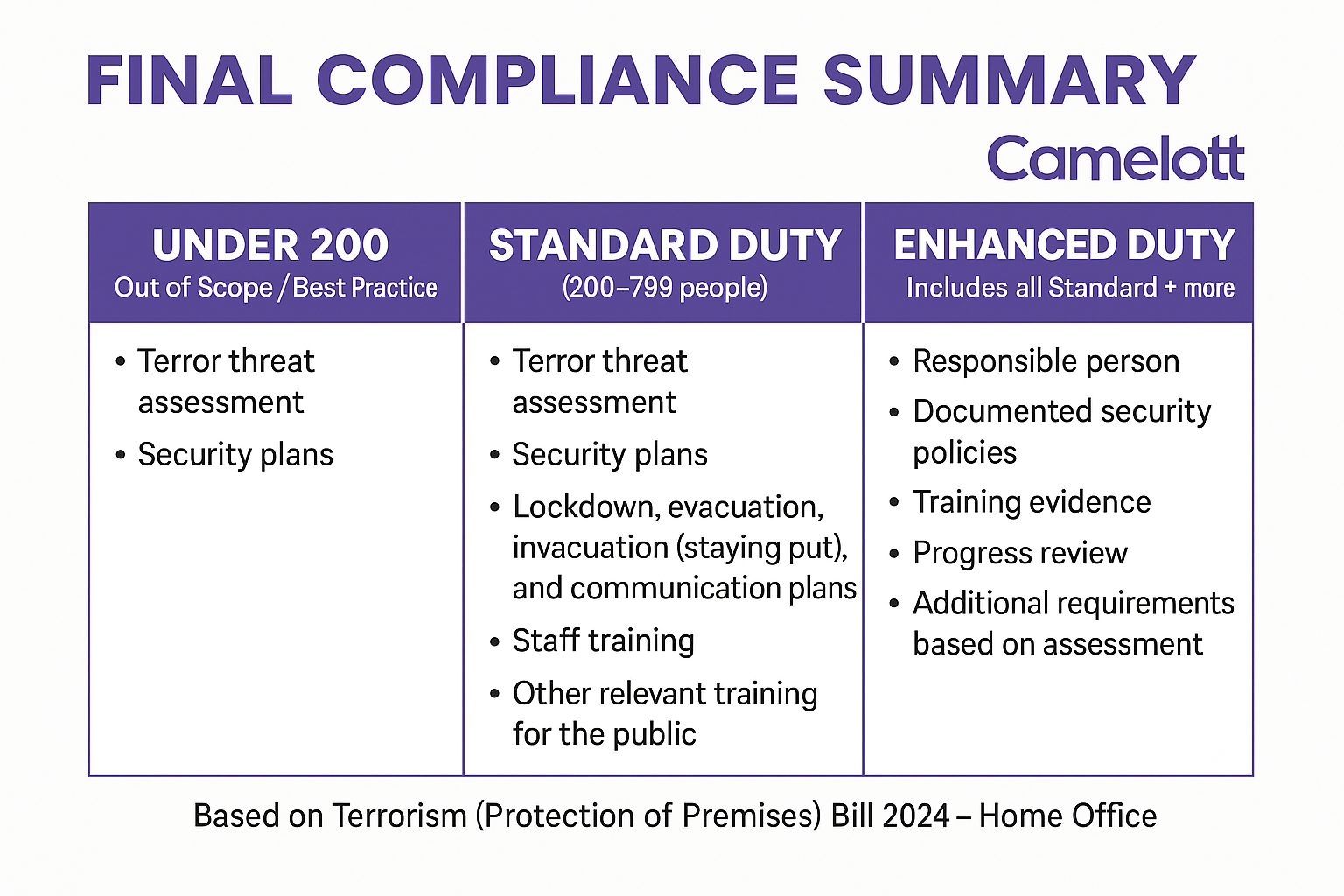
Use this graphic as a quick overview only. Current statutory guidance takes precedence, particularly where exclusions or different thresholds apply.
Where does technology fit?
Technology can support a procedure, but it should not be the starting point for deciding what the organisation needs to do.
Communication technology
A dedicated lockdown alarm, PA system, radio network, staff messaging platform or other communication method may help warn people and give instructions. The right method depends on the premises, procedure and people who need to receive the information.
Public protection measures
Enhanced Tier premises and qualifying events may need to consider physical, procedural or technical measures to reduce vulnerability or harm. What is appropriate and reasonably practicable depends on the individual premises or event.
A lockdown alarm is not “compliance technology”. It may support the lockdown and communication procedures where a dedicated warning method is appropriate, but the Act does not mandate a specific alarm product.
Read The Role of Lockdown Alarms for the practical technology side.
Martyn’s Law responsibilities — FAQs
Is Martyn’s Law already in force?
Is Standard Tier based only on a 200-person capacity?
Does Martyn’s Law require a lockdown alarm?
Do staff have to complete an approved Martyn’s Law training course?
Do organisations need to record every drill?
Need help with the communication part of your plan?
Camelott® can review how a lockdown or emergency alert could be raised and communicated across your buildings. We can help with the communication system without presenting equipment as a substitute for the Responsible Person’s wider duties.
General information only. Legal position checked against Home Office statutory guidance and SIA material available in September 2026. This is not legal advice.