
The Role of Lockdown Alarms in Martyn’s Law Preparedness
Where dedicated emergency alerting fits within a wider security procedure
The role of lockdown alarms is to help communicate an emergency procedure quickly and clearly when people may need to lockdown, invacuate, evacuate by a different route or restrict movement. The alarm supports the procedure; it does not decide the response and it does not make a premises compliant with Martyn’s Law by itself.
Current legal position: the Terrorism (Protection of Premises) Act 2025 is law, but its substantive duties are not yet in force. The SIA currently expects commencement in spring 2027, with the exact date still to be confirmed.
What is the purpose of a lockdown alarm?
A lockdown alarm is a communication control. Its job is to warn the people who need to act and give the site’s planned response a clear starting point.
Distinct from the normal fire signal
A fire alarm and a security alert can require different actions. The lockdown signal should therefore be clearly distinguishable from the site’s normal fire-evacuation alarm and other routine sounds.
Linked to a written procedure
Staff need to know what the signal means and what they are expected to do. The sound or message only becomes useful when it is tied to a clear, practised procedure.
Fast enough to be useful
Activation should be practical for the people most likely to recognise an incident. Relying on one reception desk or one vulnerable location can introduce avoidable delay.
Designed for the actual site
Classrooms, workshops, halls, toilets, playgrounds, detached buildings and noisy areas can require different combinations of audible, visual or digital alerting.
Multiple activation points
The first person to recognise an incident may be nowhere near reception. Multiple suitable activation points can reduce dependence on one central location.
Depending on the selected system and site design, activation can include fixed call points, authorised portable triggers or approved software controls. The location and type of trigger should follow the emergency procedure and the situations in which staff may genuinely need to raise the alert.
- Position activation points around realistic incident locations.
- Make activation simple enough to use under pressure.
- Control who can activate, reset or issue an all-clear.
- Test the complete route from activation to the people who need to receive the warning.
Lockdown alarm sounds, voice messages and visual alerts
There is no single universal UK lockdown tone. The warning method needs to be distinctive, intelligible and understood by the people expected to respond.
Listen before choosing an alert
Camelott® publishes 32 alarm-tone samples together with guidance on tone, voice annunciation, fire-alarm distinction and controlled all-clear procedures.
Listen to the 32 SoundsDistinctive tone
A dedicated tone can provide a simple warning, but people must already understand what it means and which procedure follows.
Voice annunciation
A short voice message can add context or instruction where the acoustics, procedure and chosen equipment make spoken information appropriate.
Flashing beacons
Visual alerts can supplement sound in noisy environments or where audible warning alone may not reliably reach everyone.
Digital notifications
Compatible systems can add desktop, monitoring, email or SMS functions where useful, but supplementary notifications should not become the only reliable on-site warning method.
Where wireless lockdown alarms can help
Wireless installation can reduce cabling and disruption, particularly on older, multi-building or fragmented sites. Radio coverage still needs to be assessed rather than assumed.
Less cabling
A suitable wireless design can reduce long cable runs, wall chasing and civil works compared with a comparable wired installation.
Multi-building sites
Detached blocks and external areas can be considered as part of the survey, with bridges or other compatible equipment used where the selected system supports them.
Expansion
Modular systems can allow compatible activation points, sounders, beacons or digital functions to be added later as the site or procedure changes.
Survey and commissioning
Building construction, distance, interference and ambient noise affect real-world performance. Coverage should be checked during design and commissioning.
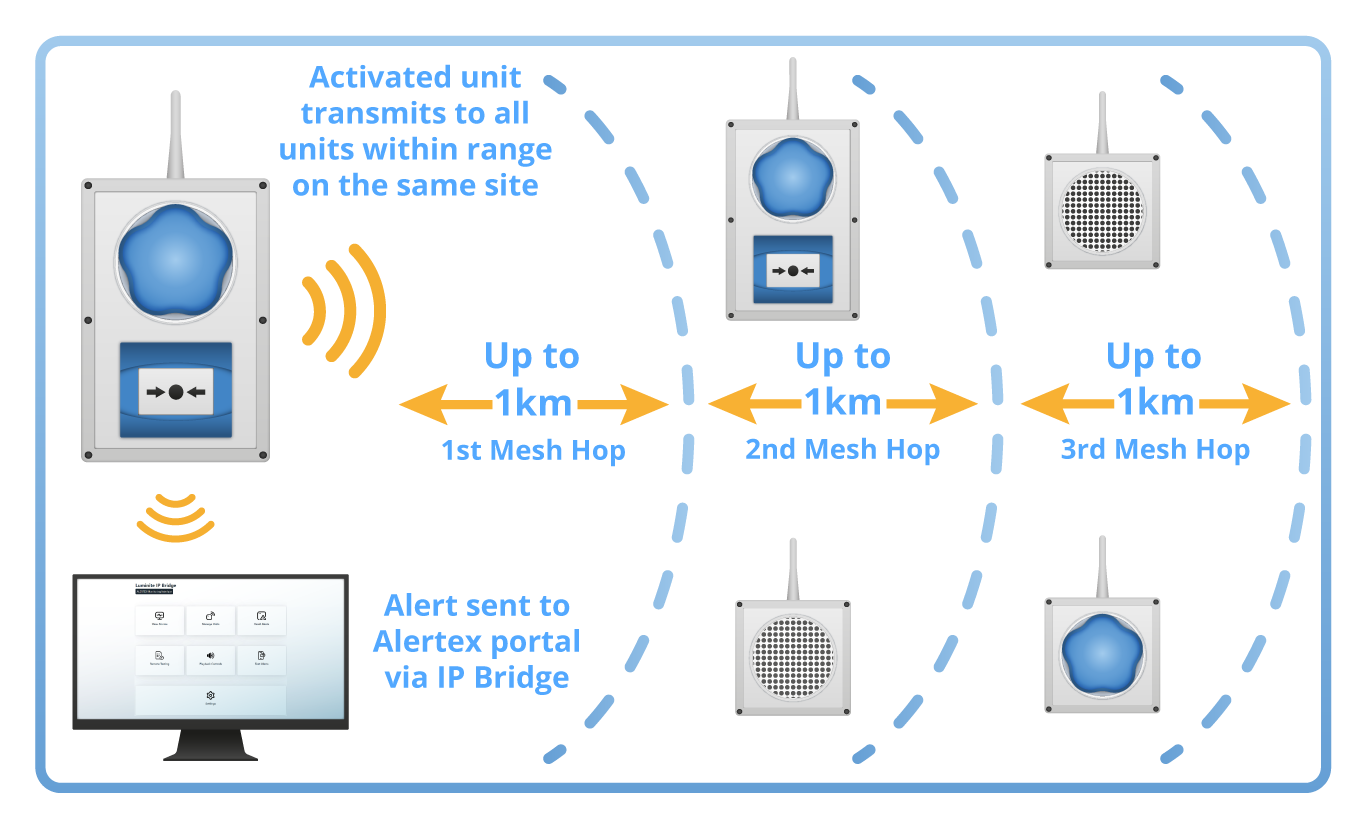
Example wireless lockdown alarm layout. Actual equipment quantities, positions and radio links depend on the site survey and selected configuration.
How lockdown alarms fit with Martyn’s Law
Martyn’s Law does not mandate a branded alarm system or a particular alarm tone. The technology is relevant only where it helps the responsible person implement suitable procedures.
The Act requires appropriate public protection procedures — including evacuation, invacuation, lockdown and communication — for premises and events in scope, so far as is reasonably practicable. Enhanced Tier premises and qualifying events have additional requirements for public protection measures and documentation.
A lockdown alarm does not make a site “Martyn’s Law ready” or compliant by itself. It may support the lockdown and communication parts of the plan where a dedicated alert is appropriate for the premises.
For the legal scope, thresholds and current implementation position, read Martyn’s Law Explained .
The role of lockdown alarms — FAQs
Does Martyn’s Law require a lockdown alarm?
Should a lockdown alarm sound different from the fire alarm?
Is a siren or a voice message better?
Can a lockdown alarm have more than one activation point?
Can wireless alarms cover separate buildings?
Is Martyn’s Law already in force?
Need to review how your site raises a lockdown alert?
Camelott® can review activation points, alert methods, buildings and the areas that need to receive the warning, then recommend a suitable system configuration. The equipment should support the organisation’s procedure, not replace it.
General information only. Legal position checked against Home Office statutory guidance and SIA material available in September 2026. This is not legal advice.